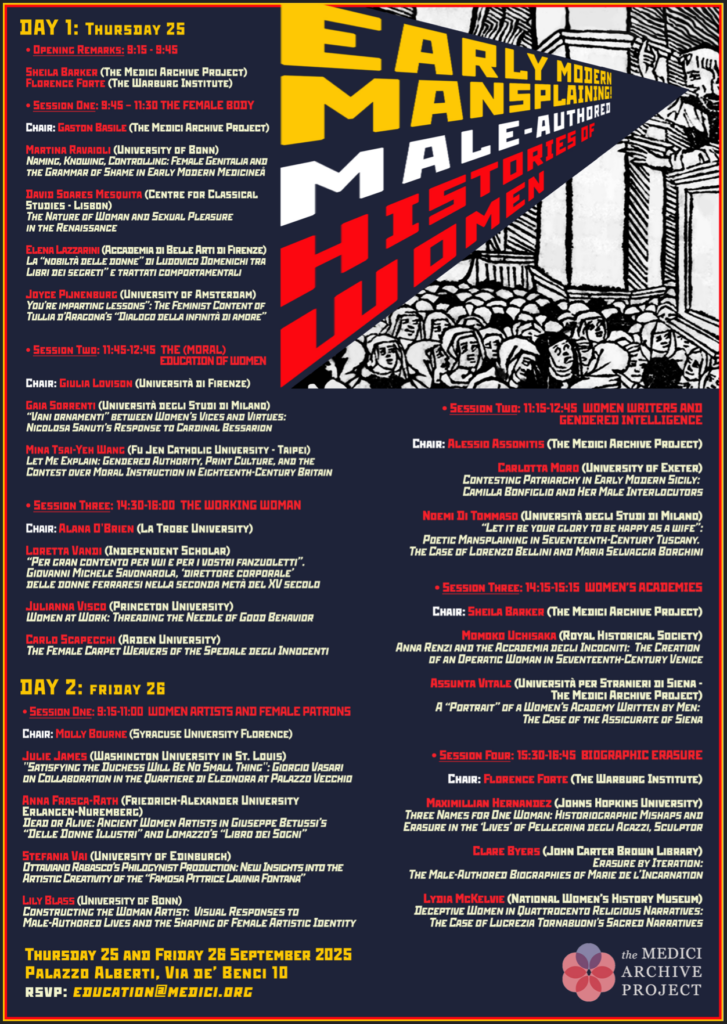
The early modern understanding of women’s historical achievements was shaped in large part by male authors. Their historiographic constructions can be found in a wide range of writings, from pro-woman treatises to hagiographies of female saints, historiographic accounts of women worthies, sermons, behavioral treatises, and even medical studies of female physiology. Some of these male authors were writing at the behest of women patrons, and in many cases it appears that their texts were intended primarily for a female readership.
One of the earliest works of European historiography to focus on women was Giovanni Boccaccio’s De mulieribus claris. Completed in 1374 and containing biographies of 106 women worthies, this landmark text was not entirely celebratory, particularly in cases where women had achieved renown in realms that Boccaccio considered to be the preserve of men. By contrast, the largest treatise to have ever been written on women’s history –comprising some 13,000 pages and compiled by Cristofano Bronzini in the early seventeenth century – was deemed excessively celebratory by the Catholic Church’s Index of Prohibited Books. This was Bronzini’s magnum opus and his dying wish was that it would one day be published, lifting his own name to prominence.
By taking a larger view of the phenomenon, we hope to learn more about the conditions under which the earliest histories of women were created and consumed.