
Call For Papers: International Workshop – Florence, 5 February 2027
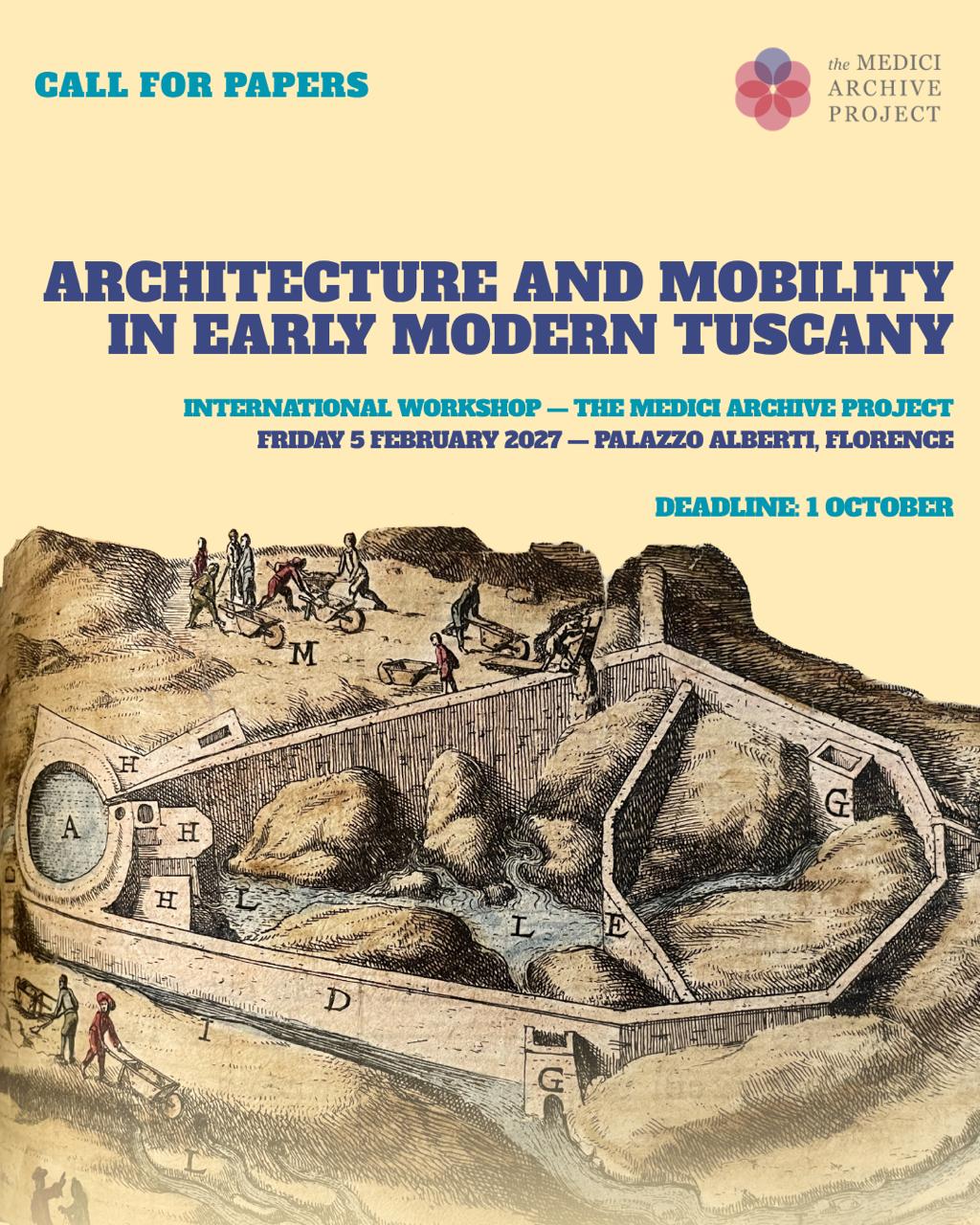
Fifty years after the publication of Giorgio Spini’s seminal Architettura e politica da Cosimo I a Ferdinando I, the Medici Archive Project is organizing a workshop addressing the interpenetration between building practices and state-building during the Medici grand duchy, with a specific emphasis on how investments in infrastructure facilitated and/or regulated the mobility of people, commodities, material culture, and intelligence in the stato vecchio and the stato nuovo. Especially welcome are papers that shed light on how civil engineering works—such as roads, canals, ports, river harbors, bridges, fortifications, dams, gates, post houses, staging inns, aqueducts, and custom houses—served as vehicles of communication, and how these networks fundamentally shaped the political success and economic progress of Medici Tuscany. Also relevant will be contributions reflecting on the creation of urban spaces specifically designated for the reception of mobility, including squares, markets, gardens, pharmacies, libraries, and neighborhoods (such as the Jewish Ghetto and the German quarter in Florence and the “foreign” settlements in Livorno and Pisa). Ideally, this workshop will begin to chart the critical topographies and infrastructure that defined the history of circulation throughout the Tuscan territory.
This initiative marks the first of four academic events dedicated to Medici architecture and urban planning. Concurrently, it feeds into a long-term research project that will culminate in an exhibition on the Medici and global news networks, tentatively entitled “How the Medici Came to Know about the World” (October 12, 2028 — January 12, 2029).
The organizers invite proposals for 20-minute unpublished papers in English or Italian which address topics including, but not limited to:
- Architects and engineers of mobility
- Architecture, mobility, and political control
- Mail and its infrastructures
- Geographies and topographies
- Squares and markets
- Inns, taverns, and prisons
- Gates, walls, and urban thresholds
- Foreign quarters and spatial coexistence
- Archives of infrastructures
- Monuments and assemblies
- Official entrate, processions, pilgrimages
- Cartography of mobility
- Hospitals and lazzaretti
- Infrastructure of water
We particularly encourage interdisciplinary approaches that engage architectural history, art history, archaeology, history, urban studies, landscape studies, and material culture.
For submission please provide a single PDF with:
- Paper title (15-word maximum)
- Paper abstract (200-word maximum)
- A short biography (maximum 250 words) or CV
- Full name, current affiliation, and email address
Email submissions or inquiries should be directed to Dr. Federico Giglio at education@medici.org.
Please submit proposals by October 1. Accepted presenters will be notified by October 15.